


After enduring the Battle of Britain and the terrors of the Blitz, Winston Churchill congratulated the British people who had weathered the storm, telling them it was their 'finest hour'. The nation had found itself as the last remaining power standing in Hitler's path. There were some who believed a compromise preferable to annihilation even if it meant the loss of the Empire or British freedom. Faced with the looming threat of Germany's Luftwaffe and imminent invasion coupled with plummeting morale and dissension within the government, Churchill rallied the British people to give their all, their life's blood, to protect their way of life and the rest of the world from Nazism and their evil designs.

For those who believe in the Great-Man theory, Churchill fulfilled his destiny when he took over as Prime Minister in such foreboding times. He would serve as a reminder to the people that they were led by a man who would stand up to the Evil that was rampaging across Europe uncontested. An unconditional faith in the British people and the civilization they had built flowed like honey from Churchill's lips. The British people needed this constant reminder to keep them in the fight. His speeches stirred those who listened and lifted the hearts of those who were overwhelmed and felt defeated. Churchill was the living heartbeat of the British nation and he would champion Britain's cause to the world showing that British grit and resolve could withstand Germany's onslaught. The British people galvanized under Churchill's watch and he fostered a national unity that would otherwise have evaporated. British historian Geoffrey Best, in his biography titled Churchill: A Study in Greatness, entitled the chapter dealing with these crucial dates as 'His Finest Hour' and rightly so (1.). Churchill personified all that was best in Britain and, like the great heroic exemplars of Britain's illustrious past, resurrected a nation that was on the brink of collapse and revived a faltering people who cried out for a leader to stand up to the evils of Hitler and Nazism. As defender and protector, Churchill was the face of Britain and his presence was an assurance to his people and an annoyance to Hitler.

What Churchill did best was provide a torrent of encouragement to a people desperate for the vaguest inclination of hope. According to Lawrence James, Churchill's "willingness to persevere come what may made him the equal of the two Pitts and Lloyd George at his best. Churchill's rhetoric, like Henry V's at Harfleur and Agincourt, set the tone of Britain's war. His words summoned up the blood and stiffened the sinews of men and women in factories and mines, on farms and battlefields."(2.) It was the span from May 1940 until September 1941 that Churchill worked his inimitable magic though the aura permeating this period was one of deep anxiety. This mood is best summed up by Churchill's daughter Mary: "never again, I think, did one feel one could scarcely breathe. We got through the days almost automatically, living from news bulletin to news bulletin, and dreading what each would bring."(3.) But not all historians are convinced that Churchill was the 'savior of his nation.'
In his review of Half the Battle: Civilian Morale in Britain during the Second World War, Rodney Lowe notes that there has been a vein of historical scholarship since the late 1960s that has attempted to undermine Churchill's legacy. In Lowe's opinion, these 'attempts' had one objective in mind – they "sought to tarnish Britain's 'finest hour'." (4.) But this trend is a view held by a minority of historians. Historians like James, Best, Lowe, and others credit Churchill with accomplishing a Herculean task that less noble men would have failed to achieve. James observes, "What Churchill said and did created a sense of national unity and purpose which was unprecedented and will probably never be revived. There was, and is for those who are its beneficiaries, something deeply moving about that spirit of 1940. Its luster will certainly survive smears applied recently by writers who either dislike its collectivist overtones or are impelled by an urge to whittle away every source of national pride."(5.)
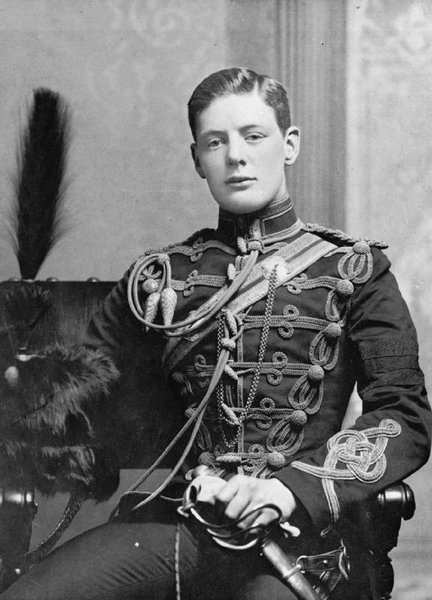
Churchill's task was precarious from the start and he showed not only the British people, but those around the world (especially America), the true substance of British character. If Churchill had been less of the man he was and showed himself to be through perilous times that tried him to his very core, then a favorable impression would never have reached Washington and America would never have provided that much-needed lifeline. These early days of Churchill's premiership were marked, according to Best, by countless speeches and orations that deeply affected his listeners whether they be a young housewife or a Cabinet member (6.). Whenever the spirit of the British people began to succumb to the uncertainties that lay ahead, they only had to listen to Churchill's voice projected across wireless into every hearth of every home. He would sustain them. He would not let them fall. He would protect them with his own body and he called on every red-blooded Briton to do the same! Churchill was able to unite the people of Britain and her government behind him. Clement Attlee observed, "We were all united in the great task of ensuring our national survival. Labour and Conservative members worked wholeheartedly together and differences on party lines did not arise. There was also unity between military and civilians . . . we had a Prime Minister who understood war and a high proportion of Ministers had served in the First World War, and this made for greater understanding." (7.)
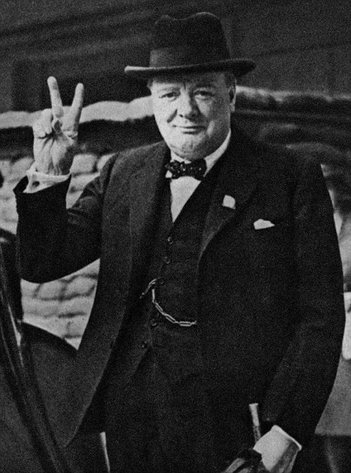
It took a rare man indeed to stand up when so many were content to fall or hide. Churchill stood defiantly against an evil he found incompatible with higher civilization. John Lukacs, in his book The Duel: the Eighty Day Struggle between Churchill and Hitler, argues that the war and civilization in general, was decided by a trial of combat, a contest of wills (8.). The best man won in Lukacs' opinion. Churchill showed Hitler and all who watched that Britain would not back down and would continue to resist the growing hand of Nazism. Even after the Battle of Britain, with the English countryside in shambles, Churchill towered above the carnage that was once a thriving economic center. A rare combination of charisma and personal magnetism made Churchill the most dynamic individual of the 20th century, a point Lukacs would agree with. Churchill possessed an indomitable spirit and it was powerful enough to lift the British nation too. The British people and Churchill formed a bond that transcended the physical world – Churchill represented each and every Briton and every Britain was vicariously connected to this powerhouse of a man. He helped to unite the British nation behind him and reawaken their desire to survive and win. The distinguished historian Richard Overy, in his review of Lukacs' Five Days in London, May 1940, believes Lukacs' work is "an entertaining and sophisticated contribution to a debate that is not over yet."(9.) Lukacs continues his argument from his earlier work, The Duel, in order to show that these first days, with Churchill assuming power, were a "turning point of the Second World War."(10.) Victory was no longer an impossibility because Churchill stood astride Britain as a Colossus. Such bold defiance, in defense of liberty and freedom, was the first mortal blow dealt Hitler. It was a powerful statement that Britain would take the fight to Germany and, if necessary, stand alone.
1. Geoffrey Best. Churchill: A Study in Greatness. (Oxford: Oxford University Press, 2001) 169
2. Lawrence James. The Rise and Fall of the British Empire. (New York: St. Martin's Press, 1994) 484
3. Best, 169
4. Rodney Lowe, a review of Half the Battle: Civilian Morale in Britain during the Second World War by Robert MacKay, American Historical Review 109 (Apr. 2004)
5. James, 484
6. Best, 171
7. Ibid, 173-74
8. John Lukacs. The Duel: the Eighty Day Struggle between Churchill and Hitler. (New Haven: Yale University Press, 1991)
9. Richard Overy, a review of Five Days in London, May 1940, by John Lukacs, The Journal of Military History 64 (Apr. 2002) 578
10. Ibid, 577