

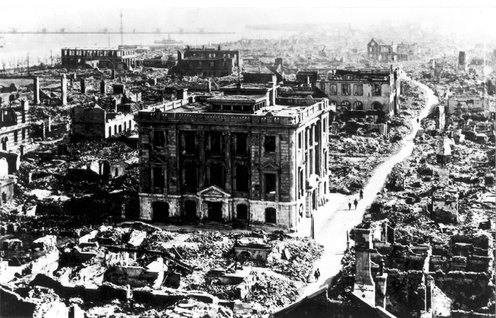
Many people have been impressed by how the Japanese are taking the latest natural disaster. But was it always like this? One explanation is that Japan is so prone to natural disasters that its people are more prepared, at least psychologically. Indeed, the Japanese tend to suffer more from natural disasters than other forms of disasters. The sense of powerlessness in face of Mother Nature fostered the culture of resignation and discipline when natural disasters strike. Education and popular culture played a part also. Even Godzilla movies are a sort of metaphor for natural disasters such as typhoons, tsunamis and earthquakes! But were the Japanese always this calm?
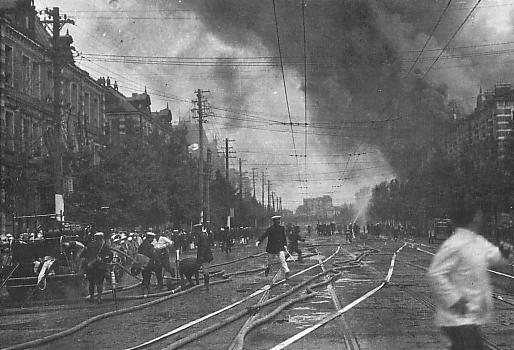
On September 1st, 1923. It was a hot, summer day. People were preparing their lunch. The quake, estimated at M7.9, struck at 11:58 am. Soon fires started all over Tokyo. Wooden houses caught fire easily and strong winds fanned the flames. Roughly half of the capital with 2.2 million people was engulfed by fire. The inferno was as bad or even worse than the ones caused by air raids by US bombers in WW2. Tens of thousands of people were burned to death. The most tragically, in one park alone, more than 30,000 refugees were burned alive. A large number of people were killed in the neighbouring port city of Yokohama and its vicinity also. Altogether, it is said that approximately 105,000 perished in the quake and the resulting firestorm.

At first little looting or violence was reported because they were busy running for their lives. There was no order. But once the fire died down, witnesses were impressed by how people helped each other, sharing little they had and exchanging kind words. People spontaneously organized themselves to rescue victims and to set up open-air kitchens. On the other hand, however, within twelve hours of the quake, some ugly incidents started, as people began to hear stories about escaped convicts and gangs of Koreans, sometimes a group of as many of 300, robbing, raping and mutilating the Japanese victims of the quake. The stories of the Korean atrocities took hold very quickly, and the frightened people formed militias. Stories got ever more outlandish, like the Koreans setting fire on houses, poisoning wells, (the muddied water was mistaken for poisoning ) and even having started the quake itself by a powerful 'quake-bomb'. The vigilantes roamed in towns, pre-emptively attacking any Korean and anyone mistaken for a Korean (including Chinese and in some cases Japanese with the regional accent from Tohoku – ironically, the region hit by the 3.11 quake!). Officially the death toll is somewhere between 200 and 300; yet some studies indicated that it could be as high as over 2,000. The killing continued until the army imposed the martial law, but some report that soldiers too joined in the killing of the Koreans. At the same time, some brave souls saved some Koreans. One police chief challenged an enraged mob bent on killing the Koreans under his protection by saying over my dead body; another drank water out of one of the reputedly poisoned wells to prove that the stories were not true.
Why did the Japanese fear the Koreans so much? People knew that the Koreans resented Japan's colonization of Korea. Korean workers' social standing in Japan was low, practically that of outcasts. People simply took for granted that the Koreans were seeking an opportunity for revenge. But there was an even more sinister side to it. It was not just the Koreans who were attacked. The socialists, the liberals, the anarchists and any other activists were arrested and in some cases methodically murdered by the police. Japan in 1923 was still smarting from an economic downturn. Japanese society had been rocked by rice riots and its nascent liberal democracy turned out to be a disappointment. Poverty was tormenting the vast majority especially in provincial towns and the countryside. Socialism was spreading at an alarming speed, or so it seemed for the authorities. The government, the police and the military feared a possible social upheaval or even a revolution (the Russian Revolution was still ongoing, which Japan had intervened, sending troops to Siberia). But perhaps the most serious aspect was that the quake might have hastened the demise of liberal democracy in Japan, which eventually sparked off wars in Asia-Pacific. The rumor has it that the rumors about the Koreans were deliberately concocted by the government to divert people's anger in the wake of the quake, since they knew their ability to restore order and to look after the quake victims was severely limited. The military thus stepped in. They helped people by providing supplies, security and transport. The public had been critical of the military for wasting tax money in the post-WW1 era of disarmament (eerily, Japan's so-called Self Defense Force after WW2 had been subject to similar criticism). But this died down quickly, as the military was now seen as the only agent that could effectively restore normalcy to Japanese society. Army officers, with overinflated confidence and sense of self-importance, began to think it proper to take their own initiative on behalf of the people. The seed of undeclared war in Asia in the 1930s, which was begun by the army without the government's consent, let alone, order, was sowed in 1923, perhaps.
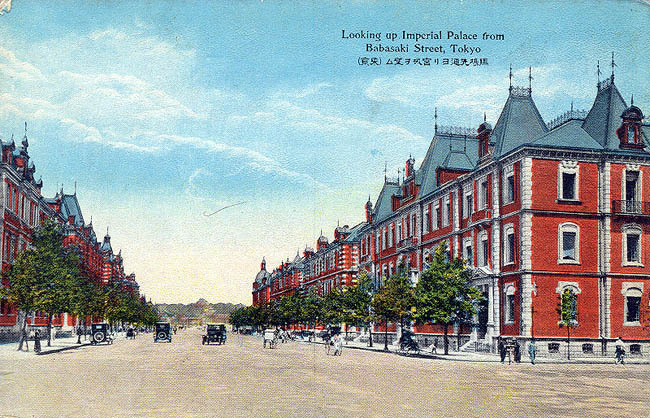
The city of Tokyo was rebuilt. But what did the quake do to Japan? The Economist is surely wrong to indicate that Japan took the path of militarism because of the quake. However, it certainly exposed the soft underbelly of Japan's fragile modernization. Japan had won No.3 military power status as the European great powers declined as a result of WW1, but it did not have strong enough social and economic bases. Today, Japan is No.3 economic power. The quake proved Japanese resilience to natural disasters, but also exposed lamentable impotence of Japan's political, economic and industrial institutions. Militarism is out of question today. Yet the deepening disillusionment with how the country is run can only get worse. The fallout, in the sense of the inherent hidden danger released in the air, is not just that of radioactive materials.
1. The figure has been downgraded from 142,000 by recent studies. M. Takemura, Shuki deyomu Kando Dansinsai (Eyewitness reports of the Great Kanto Earthquake, 2005), 15
2. ibid, 36
3. Unknown author, 'Demagogie and Genocide': www5d.biglobe.ne.jp/~DD2/Rumor/column/earthquake_demagogie.htm
4. Kanagawa University, 'The 1923 Great Kanto Earthquake: Photo/Map Database': www.himoji.jp/database/db06/relief.html
5. The labor market simply pushed them to construction and other low-end jobs. City of Osaka Social Research Department, Chosenjin Rodosha Mondai (The problem of the Korean Laborers, 1924), 39
6. Y. Nakajima, Kanto Dansinsai (The Great Kanto Earthquake, 1982), 84
7. ibid, 86
8. The Economist, March 19th, 2011