

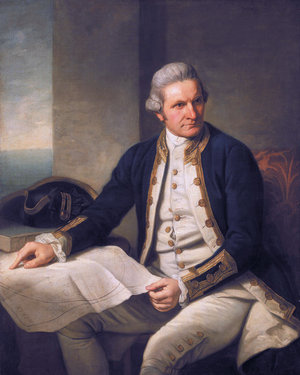
Exploration of the Pacific and Capt. James Cook are inextricably intertwined with one another. What Cook is most recognized for is "his geographical discoveries in the Pacific and Antarctic oceans, and the scientific contributions of his voyages."1 It must be remembered, however, that Capt. Cook's meanderings throughout the Pacific was not without clear objectives. Unknown lands were to be brought under the hegemony of Great Britain, profitable trade contacts were to be made, and discovery of various food sources that could be grown plentifully or replicated in the West Indies.The most pressing issue at the time, according to James, was finding an abundant food source that could be cultivated in the warmer latitudes at low cost. "Over two hundred years of overseas expansion had taught Europeans that new worlds contain products desired by the old."2

Martin Terry considers Cook's voyages and his journals describing these events as an intriguing peephole into the past rarely glimpsed. "Cook's voyages occupy this almost unique position because, from Dr. Hawksworth on, they have been the best documented."3 The panorama depicted in these journals is extraordinary. It is little wonder that readers who followed the exploits of Captain Cook relished a new installment reported in the newspapers. They sat in their armchairs many thousands of miles away reading about the latest discoveries on the other side of the world. This was gripping narrative that had its readers tightly gripping the newspaper in their hands and sitting on the edge of their seats. It was the 18th century equivalent of a New York Times Bestseller, except that this was not fiction. The peoples and plants and lands described by Cook were real; he had seen them and interacted with them. "Cook's narratives, maps, and plates made it possible for readers to hold the complex modern world in their hands as they took up his volumes and to reconsider their ideas of sovereignty, nationalism, and Empire."4
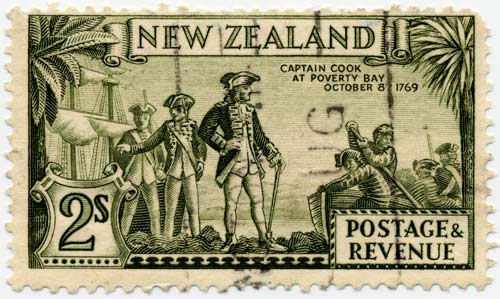
Brian Richardson, in his book Longitude and Empire: How Captain Cook's Voyages Changed the World, argues that these expeditions surpassed any to date because of the vast resources backing the expedition and its potential impact for Great Britain and the Empire. "The printed accounts of his voyages also became the ideal representation of scientific expedition literature. More than with any other voyage, Cook's travels and writings represented how and explorer ought to give an account of the world – while the voyages contained descriptions of distant places, they also discussed the practical and epistemological conditions under which certain kinds of descriptions are considered accurate and complete."5 Each of his voyages rendered more discoveries and proved a catalyst for many after him to venture into the unknown. "By mapping the Pacific Ocean with good instruments for determining both longitude and latitude, James Cook introduced new and widely influential concepts of space, territory, cultural identities, and political power . . . he also focused on islands as confined territories that sustained varied and distinct cultures. He thus opened a more complex way of thinking about native peoples – not as savages or barbarians contrasted with civilized Europeans, but as societies shaped by local geographies."6 Cook's influence was wide-ranging and pervasive. "George Vancouver came to the North Pacific in the 1790s, trained by Cook and specifically charged to further his work. And Meriwether Lewis came overland from Fort Mandan in 1805 with Cook's example firmly in mind."7 The spirit of exploration, begun by Cook, was applied by other men of intrepid vision who would go on to impact the frontiers of Canada and the American West.
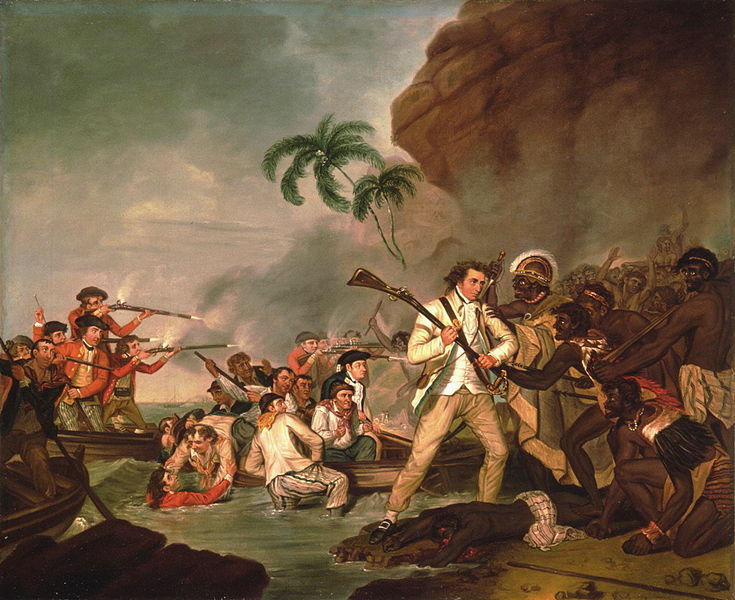
The Hakluyt Society, whose founder was responsible for the ambitious propaganda campaign to settle Virginia and the Atlantic seaboard, was responsible for diligently combing through the journals and published its latest volume on Cook's Bicentennial year. The volume currently under discussion, The Charts and Coastal Views of Captain Cook's Voyages, Volume 3: the Voyage of the Resolution and Discovery, 1776-1780, takes the reader on a journey unparalleled into the everyday life as it was lived by Cook. "Supplemented by Adrienne Kaeppler's inventories of the artifacts collected and Bank's Florilegium, or another rather sleek byproduct of 1988, one is now able in a manner unprecedented for 18th century voyages to follow cooks adventures on an almost daily basis, to determine which plants and artifacts were collected, where the respective ships were, what was observed from the quarter deck, and what was experienced on shore. This is elite reportage, from those who in a largely unlettered age could write, draw or were otherwise trained to observe. Others are necessarily silent, although each journal is studded with vividly reflected details of individual members of the crew."8 Cook's meticulously written records are invaluable today as they were when they were written. Though seen today as historical literature illuminating Cook's travels, they were seen as front-page news worthy as a cover story for each installment. Great Britain anxiously awaited word of Cook's progress, what he discovered/encountered, and what his next move was. Cook's agenda was a top priority for Great Britain and its people.
1. Ian Campbell, review of The Trial of the Cannibal Dog: the Remarkable Story of Capt. Cook's Encounters in the South Seas, by Anne Salmond, The International History Review, 27 (Mar. 2005)
2. Lawrence James. The Rise and Fall of the British Empire. (New York: St. Martin's press, 1994) 141
3. Martin Terry, review of The Charts and Coastal Views Of Captain Cooks Voyages, Volume 3: the Voyage of the Resolution and Discovery, by Andrew David, The Journal of Pacific History 35 (Jun. 2000)
4. Albert Furtwangler, review of Longitude and Empire: How Captain Cook's Voyages Changed the World, by Brian Richardson, Oregon Historical Quarterly, 107 (fall, 2006)
5. Ibid, 474
6. Ibid, 473
7. 474
8. Terry, 119