






'Izumo' is the name of one of the old, almost mythical kingdoms that preceded ancient Japan. It is in today's Shimane prefecture, opposite of South Korea across the Sea of Japan. In pre-historic times, people from Korea and possibly northern China and even Siberia migrated to this part of Japan and created this kingdom, whose wealth and power came from rich agricultural hinterland and trade connections with the more advanced parts of East Asia. It is a venerable old kingdom that has a special place in Japanese history. Hence, when Japan launched an ambitious naval programme, the so-called Six-Six Plan (six battleships and six armoured cruisers), towards the end of nineteenth century to bolster Japan's status as a naval power, that one of the most powerful, new British-built armoured cruisers should be named Izumo was no surprise.
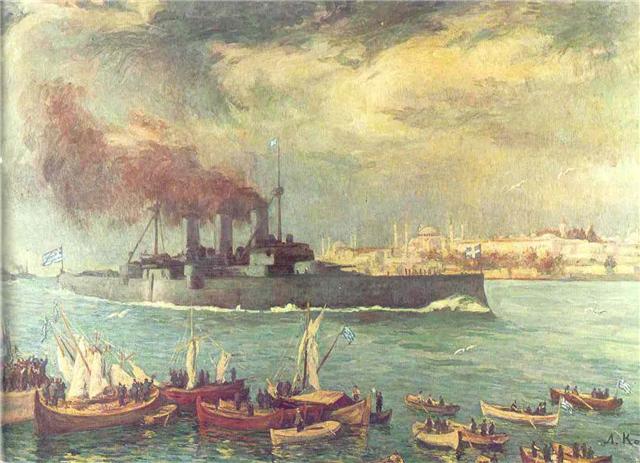
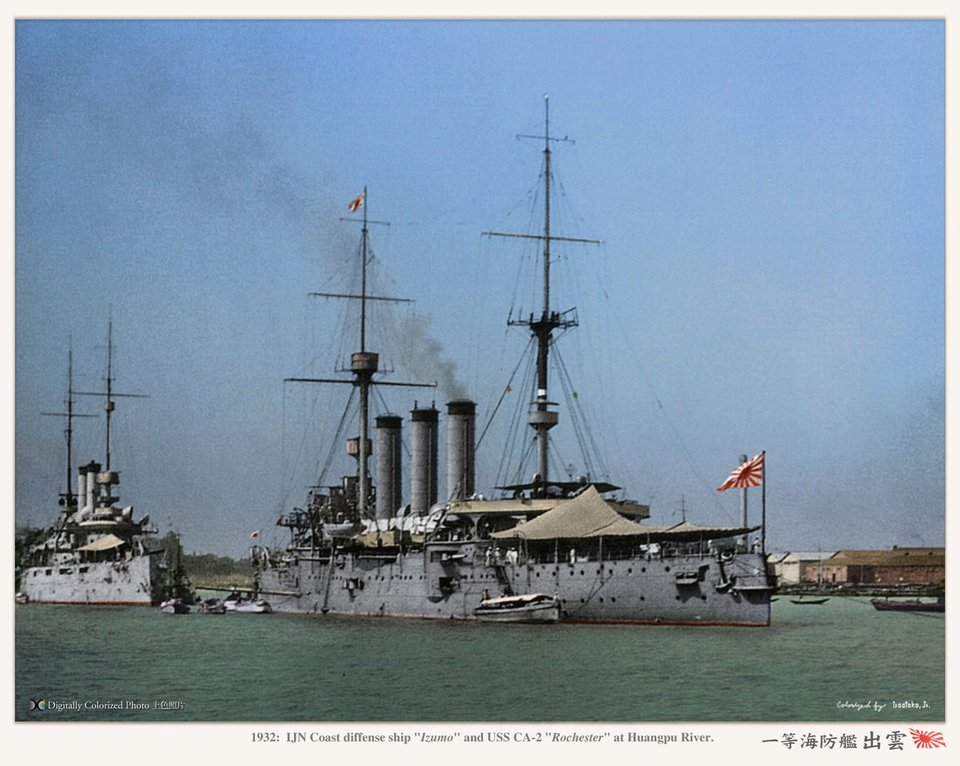
The Izumo was 9,750 tons in displacement, equipped with four 8-inch guns and fourteen 6-inch guns. (She was similar to, but slightly smaller and older than her contemporary, the Italian-made Greek armoured cruiser "Georgios Averof"). She boasted the top speed of just over 20 knots. She was pride and joy of Japanese naval men. Fought in the war against Russia (1904-5), the Izumo quickly became a battle hardened, trustworthy ship. Just prior to the outbreak of WW1 (1914-18), she demonstrated the Japanese navy's long reach by operating just off Mexico, protecting Japanese interests there. WW1 was indeed Japan's opportunity. Taking advantage of British shortage of ships and using the Anglo-Japanese Alliance as a pretext, it joined the war on the British side and began to hunt down the German commerce raiders including the powerful squadron led by von Spee, which threatened Allied shipping in the Pacific.
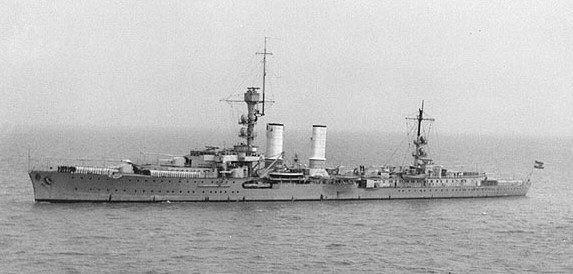
The German cruiser, the Emden, operating independently, in fact did most damage, sinking or capturing over 70,000 tons of Allied shipping. The Allies were desperately trying to catch her. Since the US was still neutral, the British had no choice but to accept Japanese help in their effort to find and destroy the gallant German cruiser and Spee's squadron. Although Spee was eventually dealt with by the British off the Falkland islands and the Emden was finally nailed by the Australian cruiser Sydney, the Japanese contribution was not insignificant. The very presence of the Japanese naval forces including the Izumo off US and Mexican coasts directly led to Spee's decision to sail south to the waiting hands of the British. The Emden was also driven to the Indian Ocean, chased by the combined Anglo-Japanese forces in the Pacific. The Izumo, stationed off Mexico, indeed paved the way for the Japanese naval forces operating in the northern Pacific. Later, as Japan's area of operation expanded, in 1917, the Izumo was sent to the Eastern Mediterranean to join the Japanese anti-submarine and anti-mining flotilla deployed there. She'd even sail to British waters to participate in disarming of the German navy at the end of the war.
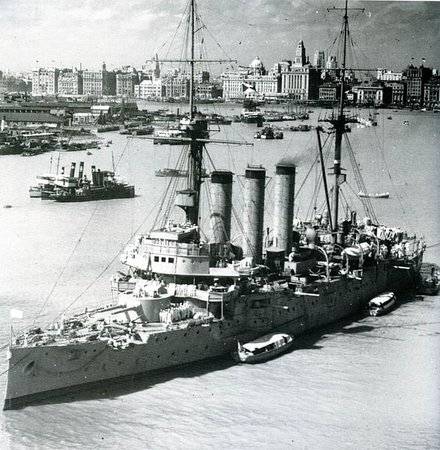
As a result of WW1, Japan's naval power increased significantly, setting the strategic scenes for the wars in the 1930s and WW2. The Izumo was considered as an old, antiquated ship by the 1930s. She had been designated as coastal defence ship and was used for training. Yet she was still useful in narrow, confined waters and thus brought back to active duty as the Sino-Japanese war broke out. In 1937, as the flag ship of the Third Fleet, she saw action in Shanghai, where she fought off Chinese navy and air force. She captured or sunk American and British gunboats in Chinese waters as war started with the Western allies in December 1941. Then she was back to semi-retired status, and was eventually sunk in an American air raid. She was raised and scrapped in 1947, ending her valiant half-century career. For her prominent presence in China at the beginning of the conflict between Japan and China, the Izumo was remembered as spearheading the Japanese invasion of China, although this point is lost on most Japanese. She is largely forgotten by collective memory of the Japanese, since she was not a part of the main combat fleet.
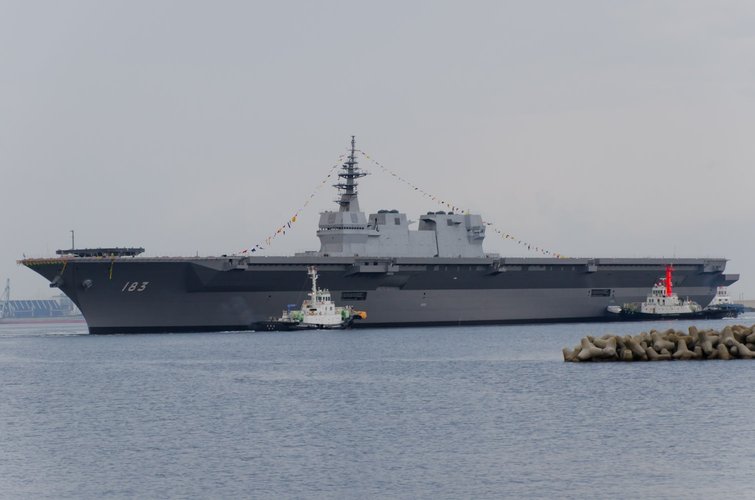
In the post-war years, the Japanese navy, called the Maritime Self-Defence Force, was practically an auxiliary fleet in support of the US Navy in cold war strategic environment. Thus most of its ships were classed as 'escort ships', which were in effect frigates and destroyers with names like 'Sea Breeze' or 'Morning Mist'. Recently, however, as Japan began to acquire more powerful combat vessels such as Aegis destroyers and helicopter carriers, they were named after capital ships of the Japanese navy in WW2. Now, they will have a new Izumo (DDH183) — a 20,000-ton aircraft carrier all but name, capable of operating nearly a dozen large helicopters. She is larger than the British Invincible class carrier (or 'through-deck cruiser') and almost as big as the US Essex class amphibious assault ship. Though she is officially a 'helicopter destroyer' intended for anti-submarine operations, maritime security policing, humanitarian relief and transportation operations, she appears certainly capable of staging a small amphibious operation on her own. The FA-18 naval fighter cannot land on her, but it is reputed that the new F-35 VTOL fighter could. So Japan's neighbours are worried. The Japanese probably picked the name Izumo as it is not associated with painful memory of the war (unaware of the fact that the name is still painfully remembered in China) and representing the spirit of international cooperation (i.e., with the British then; with the US fleet now); however, immediate reaction from her Asian neighbours, especially that of China, was one of alarm and trepidation to the chagrin of both the Japanese government and the public (1.). Launched in the summer of 2013 and not even yet commissioned, the Izumo is already sailing into turbulent waters. The armoured cruiser Izumo had a distinction of fighting naval forces of Russia, China, Germany, Britain and the United States and sailed in the China Sea, the Pacific, the Indian Ocean, the Mediterranean and European waters. Not many Japanese warships share such colourful history. The new Izumo, on the other hand, certainly needs a careful navigation through perception gaps in Asiatic waters alone.
1. Numerous Japanese websites, blogs etc. deride Chinese paranoia, as the Japanese think that they have innocently picked a name from Japanese history. Witness, for example:
http://blogos.com/article/77538/;http://sankei.jp.msn.com/world/news/130820/asi13082009280001-n1.htm;http://bylines.news.yahoo.co.jp/eikenitagaki/20140109-00031394/ (last checked on January 25, 2014)
Bibliography
Halpern, P.G. (1994) A Naval History of World War I. Annapolis.
Hirama, Y. (1998) Daiichiji Sekai Taisen to Nihon Kaigun ['The First World War and the Japanese Navy]. Tokyo.
Yates, K. (1995) Graf Spee's Raiders. London.