






In the mid fourteenth century the principalities of the Russia had been in the thrall of the Mongols for more than a century. By this time the Mongol Empire had broken up into several "Hordes" who ruled independently of one another. The Russian principalities were ruled by Golden Horde and these descendants of Juchi; Genghis Khan's general, became Islamicized and came to be known as Tatars. The Golden Horde made its capital at Sarai on the Volga, where it could keep an eye on the Russians, and maintain contact with the ancestral homelands to the east. The Tatars of the 1350's were probably not of the same calibre as the disciplined armies that Genghis Khan led in the thirteenth century, but the Russian princes would still make the journey to Sarai, where they could receive an investiture to rule, but occasionally the executioner's garrotte, depending on the will of the Great Khan. The princes of Russia were allowed to rule more or less as they pleased within this arrangement and were far more likely to wage war on each other rather than challenge armies of the Horde. Within this context of clientship several principalities like Tver and Muscovy were able to play a perilous game of extending their territory and influence. The patronage of the Great Khan replaced the traditional Riurikid blood line as the criteria for becoming Grand Prince.
The first significant defeat of the Golden Horde's armies in Europe was not inflicted by one of the Russian principalities but by the Grand Duchy of Lithuania. At a site now lost, on the banks of a river somewhere in the southern Ukraine, the battle of Sinie Vody – or the Blue Waters – was fought, between an army of Lithuanian pagans and three Tatar warlords. Information about the battle is sketchy but there is contemporary chronicle evidence of the event. It is an irony that Christendom's great scourge was first significantly defeated in Europe by the Pagan Grand Duke Algirdas, who worshipped the thunder god Perkunas. Outside the scholarship Eastern European Medieval history knowledge of Lithuania's time of empire building is largely unknown, as is the fact that an openly pagan country was such a significant force in Europe in the late Middle Ages. But how did such a primitive realm with so few obvious advantages come to be such a big player in the politics of the time? Lithuania's advent onto the medieval stage was inauspicious at best. The country was a wild and backward place even for the north eastern frontiers of Christendom. The terrain consisted of vast impenetrable forests, punctuated by marshland and bogs. The climate was appalling for travel, especially in spring and autumn. Indeed the wilderness was so dense and uncultivated that it provided a refuge for some of Europe's last surviving species of mega fauna such as the auroch, bison and giant stag. The area was extremely poor in natural resources with very little in the way of mineral and agricultural wealth, having only animal furs and amber from the Baltic to export. The country was not densely populated but the inhabitants brought extra wealth in through banditry, conducting raids for cattle, slaves and mineral riches. The position of banditry in the economy and social order had a profound influence on the development of the Lithuanians' warrior society but did not endear them to their neighbours.
It was also Lithuania's fate to be situated in a particularly dangerous corner of Europe in the middle ages. To the east were the Russian principalities, dominated by the Mongols. It shared a border with the rising power of Poland, but the greatest threat came from militant Christendom, as Lithuania was situated between two branches of an order of crusading knights on its northern and western borders, whose main purpose was to stamp out this last outpost of paganism.

The Northern Crusades: The so called Northern Crusades and their foremost protagonists; the Teutonic Knights played had a fundamental impact on Lithuania's development as a major power. As well as being under developed and prone to raiding their neighbours the Lithuanians remained devoted to pagan beliefs which, in the age the crusades this was casus belli enough. In the twelfth century the knights and adventurers of Northern Europe began to see the potential of starting a fresh crusade against the various Balt and Slavic pagans on their own frontiers. Papal sanction was given in 1147, but the pressures of land hunger and desire for salvation were more than enough to drive the knights of Germany and Scandinavia eastwards to make war on the local heathens. By the beginning of the thirteenth century knightly orders appeared like the Knights of Dobrzyń and the Sword Brethren in imitation of the Hospitallers and Templars. The Northern Crusades were considered something of a side show, but they were given a considerable boost when the crusades in the Middle East began to unravel in the late thirteenth century, and the kings of Europe turned on orders like the Templars, jealous of their great wealth. The danger to Lithuania was sharply underlined by the conquest of its western neighbour; Prussia, over the course of the thirteenth century. The Prussians were ethnically very close to the Lithuanians; they spoke a Baltic language similar to Lithuanian and worshipped the same gods. Economically they were more advanced and had a greater population. Prussia's conquerors; the Teutonic Knights, were founded in the Holy Land, but were drawn to the Baltic frontier because most of their brethren were German and they had been invited by Duke Conrad of Mazovia, an autonomous Dukedom of the greater Poland, to fight the Prussians. The Knights insisted on being granted an independent province, and from their base at Chelmno they systematically conquered Prussia, and formed a sovereign state. Fierce revolts broke out, aided by other Polish dukes, now nervous of this new power, but the Teutonic Knights won through, using their discipline, the latest military technology and their clarion call to western chivalry to defend Christendom. Lithuania had not been neutral in these wars; they had fought the Order throughout and taken military refugees from Prussia, with knowledge about fighting the Knights. The chronicler of the Teutonic Knights, Peter of Dusburg, wrote that in 1283 the war for Prussia was over, but the war for Lithuania was about to begin. This could well have spelt the end of the Lithuanians' independence, as it had for pagan tribes like the Estonians, the Livs, but from the outset the Lithuanians, and their subjects, the Samogitians, demonstrated they were not to be taken lightly. In 1236 the Sword Brethren launched an ill planned expedition into the Samogitian interior, but it was surrounded and cut to pieces. The Sword Brethren ceased to exist as a credible order, and although the Teutonic Knights capitalised on this event by merging with this order and its Livonian territories, this could not mask the disaster for the crusading movement.
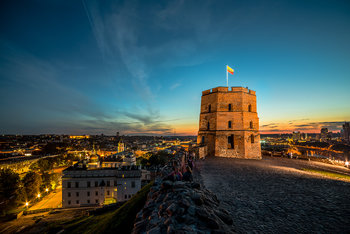
How the Grand Duchy of Lithuania Survived: This did not improve Lithuania's prospects, for now the Order was on two of its frontiers. Despite this Lithuania had a number of unique features that contributed to its survival. The first pillar of Lithuania's defence was the wild and inaccessible nature of the country itself. It was no coincidence that paganism survived in this region of dense forests and treacherous marshlands. For the pagan inhabitants the forest was the abode of spirits and deities, whose favour was needed for victory. The Lithuanian warrior was in his element in the forest and knew best how to utilise this wild realm; to set ambushes, draw an enemy into a trap and to disappear after a raid. The seasons also played their part in Lithuania's defence. The Teutonic Knights favoured high summer or mid winter to launch their raids, as the torrential rains of spring and autumn could literally wash paths away. The perception of the wilderness as the dwelling place of evil spirits was shared by the Crusaders within their own world view, and although the Teutonic Knights became experts at this type of fighting the strange linear war along the rivers Neris and Nemunas defied an all out victory for either side. The wilderness of the Baltic seaboard was a formidable barrier, but it did not fully explain the Lithuanians' success in warfare. The second pillar was the Lithuanian warriors, who were as effective in the plains of the Ukraine, and the tilled farmlands of Prussia and Poland as they were in their forest homeland, and held the own against the best of European chivalry, the Russians and the Tatars. The Lithuanians lived in a warrior society that was descended from bands of raiders who lived by banditry. This was a noble society in which the boyars ruled over a subservient peasantry, and led retinues comprised of their own extended families. The boyars owed their allegiance to princes who could summon the boyars into greater war bands in time of need. An early account of Henry of Livonia remarked that Lithuanian light cavalry reproduced Tatar cavalry tactics using light javelins instead of bows to shoot from the saddle. The Lithuanian warrior was highly flexible; he could fight as infantry, especially in the forest, and proved adept at adopting and adapting western European military techniques. Ways were found around the Papal embargo to get hold of the latest western European weapons, including gunpowder and ordnance when it appeared. Alongside this there were local adaptations; the Lithuanian army was able to utilise sledges and skis, for campaigning in deep winter. The war bands were knit together with a powerful code of honour which was closely bound up with their religion. There were several Gods, but there was especial reverence for Perkunas the thunder god, of war and fertility. He rode a fiery steed called Lieponotos, and the importance of horses as messengers of the Gods reflected the reality of the Lithuanian warriors' reliance on the horse in warfare. The Gods gave victory, and a successful war leader was considered favoured, but this was not left to chance. Sometimes up to a third of booty could be ritually burnt as an offering. Offerings were not always inanimate. A facet of the Lithuanians' martial religion that most shocked their enemies was their practice of human sacrifice, and not least because they would choose the noblest prisoner to be burnt alive, often in full armour. It may have been uncommon, but was not simply Christian propaganda; in 1320, Gerhard of Rude the Vogt of Samland was documented as one who suffered this fate. The Grand Dukes of Lithuania, as representatives to the Gods, had various ceremonial duties to perform in the open air sanctuaries among the sacred trees, but the primary sign of divine favour was success. This requirement must have been significant in giving Lithuania the third pillar of its power, as it was fortunate enough to be ruled by a dynasty of dynamic, ruthless and innovative grand dukes. It was the Gediminids who raised Lithuania from a land of raiders to the builders of an empire. It should also be born in mind that the central core of Lithuania's empire, although close to the boundaries of the modern nation, comprised two closely linked provinces. The Lithuanians, or Aukštaitija in their own language, had their power base in the mountainous south east of the country, but they ruled over the Samogitians or the Žemaitija, of the north western lowlands. The Samogitians were also pagans, and ethnically and linguistically very close to the Lithuanians. These tribesmen were less cultivated and even more devoted to their gods, and they bore the brunt of the Teutonic Knights' attacks. This bound their fate closely to that of their more ambitious cousins, but later events were to test their loyalty to breaking point. The first notable Grand Duke of the dynasty, Vytenis (1295 – 1315) demonstrated his primary function as a war leader by responding to the Order's raids on Samogitia with a devastating series of raids of his own on Prussia and Livonia, which heralded the arbitrary start of the war for Lithuania. It was for his brother Gediminas (1315 – 1341) to give his name to the dynasty vastly extend its realm. Their generalship was renowned but it was perhaps in the arts of diplomacy that the Gediminids most excelled. Although pagan the Gediminids were bolstered by a network of marriage alliances, and were known to loan their armies to friendly Christian kings to make war on their co-religionists. The Grand Dukes were also well informed and showed great skill in exploiting their opponents' weaknesses, often by using the forlorn offer of conversion to Christianity. Vytenis was able to install a garrison in Riga, Livonia's greatest city, on the vague assurance of conversion, because the Arch Bishop and burghers of Riga had grown to detest the rule of the Teutonic Knights. Gediminas was even more cunning, and was able to exploit the Pope's eternal optimism that he might come to the Christian fold, by means of an ambiguously worded letter in the 1320's. In this way Gediminas hooked the Pope into pressurising the Order to make peace. When papal envoys eventually did find their way to an audience in Vilnius, Gediminas replied that he was happy to acknowledge the Pope as his father in respect of his venerable status but had no intention of converting. Although peace with the Order was useful Gediminas had much to lose if he became a Catholic Christian. For one thing his pagan boyars and the Samogitian tribesmen were loyal to their old gods, and Gediminas had the fate of Mindaugas, Lithuania's first great ruler who faced revolt and murder after his conversion, of what could befall him. Secondly an ever growing proportion of Gediminid territory was Greek Orthodox Christian. The Rus'ian principalities had no desire to be ruled by a Roman Catholic, and the Teutonic Knights were the sworn foe of schismatics as well as heathens. Strangely being pagan gave the Gediminids the advantage of neutrality, as they were not aligned to a great religious bloc. Pragmatically Gediminid princes were expected to become Orthodox Christians, and rule the Rus'ian principalities in accordance with their traditional laws and customs. Within Lithuania the Gediminids adopted a policy of religious toleration almost unique in medieval Europe. Immigrants were welcome in Lithuania, and skilled settlers were well rewarded. Churches and monasteries were positively encouraged by Gediminas in order to make the artisans and merchants feel at home. Catholic and Orthodox Christians worshipped freely, as did resident Jews and Muslims. The only time when this religious toleration lapsed was when some Franciscans preached against the pagan faith of their host, for which they were martyred.

The Drive to the East: Lithuania's wars against the Order were intense, but they were largely defensive. The raids into Prussia and Livonia were for destruction and booty, not for conquest. For the Gediminids the eastern frontier with the Rus'ian principalities was the place for expansion. The process began back in Mindaugas's reign when he extended his sovereignty over some of the forested north western principalities such as Minsk and Polotsk, which the Tatars had not dominated directly. In the reign of Vytenis and Gediminas the rest of what is now Byelorussia such as Vitebsk came under Lithuanian domination. In south western Rus'ia Lithuania vied with Poland for decades for control of the principalities of Galicia and Volhynia. For Lithuania this expansion into Rus'ian lands held a number of advantages. Boyars with lands near the turbulent Prussian and Livonian frontiers could be induced to fight longer with the pay off of receiving new estates in the new lands to the east. Also, large numbers of Rus'ian soldiers, especially archers, participated in the wars with the Order. Gediminas's ambitions were indicated by the new title he devised of Lethewindorum et Ruthenorum rex, meaning lord of the Lithuanians and Rus'ians, but his actions spoke louder. In 1322-3 Gediminas's army stormed through Southern Rus'ia, beginning in Volhynia, and carrying city after city, by conquest or submission. His way to Kiev was blocked by the combined armies of the Princes of Kiev, Pereiaslavl and Briansk. At the battle of the River Irpen in 1323 Gediminas scattered his enemies and once Kiev capitulated after a month's siege the other princes were quick to offer their submission. Gediminas then installed his own men as rulers in Kiev. The precise nature of Lithuania's rule in the Rus'ian lands is difficult to pin down and is much debated. Although principalities were often taken by force this was not always the case, as some Lithuanian candidates were invited it. Gediminid princes always to converted to the Greek Orthodox faith, promised not to impose any new laws, nor to interfere with the customs of their new subjects. Pagan overlordship had a kind of neutrality, and was infinitely more acceptable to the Orthodox Rus'ians than Catholicism. Also there is evidence that Kiev still paid tribute to the Great Khan after Gediminas's conquest. Some later commentators even allege that Lithuanian rule was at the invitation of the Rus'ian cities, and was entirely peaceful. This view is somewhat extreme as Gediminas achieved much by conquest and was quite prepared to shed royal blood in his campaigns. From the position of the newly conquered principalities, it was probably best to make do with your new master, but to also not to risk further bloodshed by withholding the Golden Horde's tribute either. The attitude of the Great Khan in Sarai is also difficult to gauge. The Tatars launched raids against Lithuania in 1325, perhaps in response to Gediminas's activities, and gave military forces to help Moscow and Suzdal in their unsuccessful attempt to wrest Smolensk from the Lithuanian candidate in 1339. Apart from this the Great Khan did not make any serious attempt to counter Lithuania's penetration of the Rus'ian territories. The Golden Horde certainly monitored Lithuania's activities, but seemed reluctant to act as long as the tribute kept coming in from the Rus'ian principalities. The collection of this tribute was most often carried out by the Princes of Moscow, who manage to override their dynastic illegitimacy to most often hold the title of Grand Prince of Rus'ia. This was achieved mainly on the ability of candidates like Prince Ivan Kalita to deliver the gold to Sarai. However, Lithuania may have been tolerated as a counter balance, lest Moscow became too powerful. This loose balance of power might have continued had not the Golden Horde fallen into a period of strife. A legitimate claimant to the Khanate had to be a descendent of Juchi, and thus Genghis Khan. This system worked relatively well until the death of the long reigning Janibek in 1357. He was succeeded by his son Berdibek. In 1359 Berdibek's brother Qulpa displaced him but was unable to stay on the throne himself, and the Golden Horde was plunged into civil war for the next two decades. Khans changed on a yearly basis, often merely the puppets of non-Juchid warlords. Most notable of these was Mamai, a former general of Berdibek's, who was a key player in the civil war. The territories of the Golden Horde also became divided by the rival factions. The princes of Rus' ceased to travel to Sarai in person, not from recalcitrance but for their personal security, so dangerous and chaotic had it become. The Lithuanians saw opportunities in these events but they had had their own problems. With the death of Gediminas in 1341 or 1342, his royal house underwent its own period of disputed leadership, which resolved itself in 1345 under the rule of two sons; Algirdas and Kestutis. Algirdas held the title of Grand Duke, but these brothers formed a dynamic partnership for what was in reality a two man job. Kestutis, based at Trakai, was in charge of the war with the Teutonic Knights, at a time when they were led by perhaps their most effective leader; Grand Master Winrich von Kniprode (1352 – 1382). Algirdas governed from Vilnius and mainly focused on the Grand Duchy's eastern possessions.
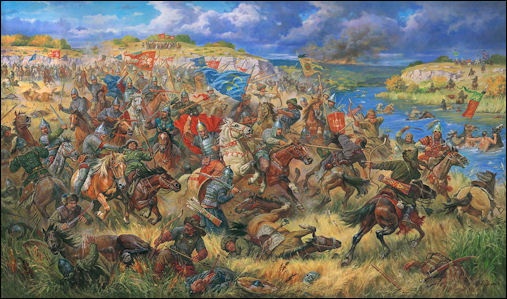
The Battle of the Blue Waters: Prior to the Horde's civil war Algirdas had been extending Lithuania's power; placing his candidates to rule in Briansk, Chernihiv, Novhorod-Siversky and Starodub. In around 1360 Algirdas deposed Theodor, the "last Ukrainian Prince of Kiev" according to Hrushevsky, the great Ukrainian scholar, and installed his own son Volodimir. However, Kiev was of symbolic significance and Theodor was considered a vassal of the horde, and the Khanate was in danger of losing prestige. Therefore it was probably against this background that the leader (or leaders) of the Golden Horde dispatched a force to deal with this threat from the Lithuanian pagans. At this stage in the saga we run up against the paucity of source material. We have no way of knowing which khan or pretender dispatched an army to take on the Lithuanians, and to the lasting detriment of their historical legacy the Lithuanians were not prolific chroniclers or self publicists. However, the earliest versions of the Lithuanian – Ruthenian Chronicle report that 1362 "[Algirdas] embarked on a campaign and defeated the Tatars at the Blue Waters [Sinie Vody in Ukrainian]". The next problem that arises is precisely where the battle took place. There are several rivers called the "Blue Waters" and the two most favoured options have been the Siniuka, a tributary of the River Bug, and the Snyvod, on the border of Kievan territory. A later chronicle gives us more information. This refers to Algirdas defeating "three Tatar brothers – Kochubey, Kutlubuh and Dimitro – who had ruled over Podolia and collected taxes there." Podolia is the region below Kiev, which Lithuania came to dominate, eventually bringing its power to the Black Sea. The first two names are clearly of Tatars, but "Dimitro" or Dimitry would seem to be a Rus'ian ally or vassal. Unlike later battles we have no fuller picture of the events of the day, reliable or otherwise. However, in light of the references to Algirdas's advance, it seems logical that Algirdas could have learned that his dominance of Kiev was being challenged, and went to meet the Tatar army, with its Rus'ian allies (as indeed Algirdas probably had too) that had been dispatched from Podolia, and defeated them on the banks of a river, at a site now lost to history. The battle was not only evident from its mention in the chronicles, but also its impact on the scene. The chronicle goes on to state that Algirdas established various relatives as rulers of Podolia, and "put a stop to the payment of tribute to the Tatars", as well as fortifying the cities of the region, something which had been forbidden under the Tatar Yoke. The Golden Horde was not finished, and incidents of occasional tribute paying were to recur again, but essentially the central Ukrainian lands were taken out of Golden Horde's domain, and for many years became part of a wider Lithuanian realm. On this basis the battle of the Blue Waters can be considered decisive. The question arises as to how such a noteworthy event became essentially forgotten. One event that overshadowed the battle in the chronicles at least was the battle of Kulikovo in 1380, in which Prince Dimitry of Moscow defeated Mamai, a non-Juchid warlord who was vying for predominance. Muscovite chronicles celebrated and amplified this event for years to come. This achievement was remarkable but the gains were obliterated when the next pre-eminent Tatar, Tokhtamysh, sacked Moscow in 1382. Dimitry Donskoi continued as an obedient and paying suzerain; it was another century before Moscow would see the end of the Tatar Yoke. The major factor which obscured Lithuania's achievement was subsequent historical events. With the Union of Kreva in 1385, Grand Duke Jogaila, Algirdas's son, undertook to become Catholic under Polish auspices. Jogaila thus was able to become King of Poland, and set about imposing Catholicism on his Lithuanian subjects. Lithuania was now bound to Poland and Catholicism. This alienated the Greek Orthodox territories, and precipitated a drift away from their formerly less objectionable overlords. As stated above a heathen overlord was preferable to a Christian of the wrong kind, and there was little interest among the Ukrainians in celebrating Lithuania's achievements against the Tatars after this apparent betrayal. In subsequent centuries Lithuania's link with Poland also entailed sharing Poland's fate as one of the most unfortunate nations of the early modern era, with its great loss of territory, prestige and autonomy in the face of Germany and Imperial Russia, the two giants of Central and Eastern European history. Lithuania's early achievements became a footnote with no champions to keep the memory alive. In the southern Ukraine the search for the battlefield continues, and in recent years archaeologists have been concentrating on the village of Torhovytsia on the River Syniukha, but as yet the soil has refused to give up the site of one of the greatest battle honours of Lithuanian arms.