


In most books on naval history, we see a massive gap in the Roman period after the battle of Actium, which decided the fate of Anthony and Cleopatra. Pax Romana then broke out under Octavian; no more epic naval battle took place because the Empire successfully removed all naval and maritime threats to civilizations in the Mediterranean basin. The Roman peace meant that the Empire no longer needed a navy. Roman naval forces at the height of the empire consisted of small force performing the tasks of coast guard and police, keeping maritime traffic safe for traders and travellers. And yet, as the grip of Roman power waned from the third century on, the need to rebuild a navy arose.
When Constantine the Great defeated his rivals to become the sole emperor of the empire and moved the capital from Rome to Byzantion in 330 AD, his climactic battle against Maxentius following his 'conversion' to Christianity, having seen a cross over the sun, did not end the civil war. He still had one remaining rival, Licinius, to eliminate, which he achieved by building a navy to control seas around Byzantion, the base of Licinius.
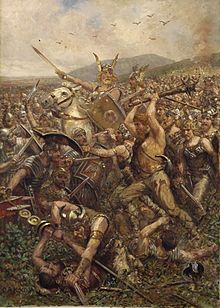
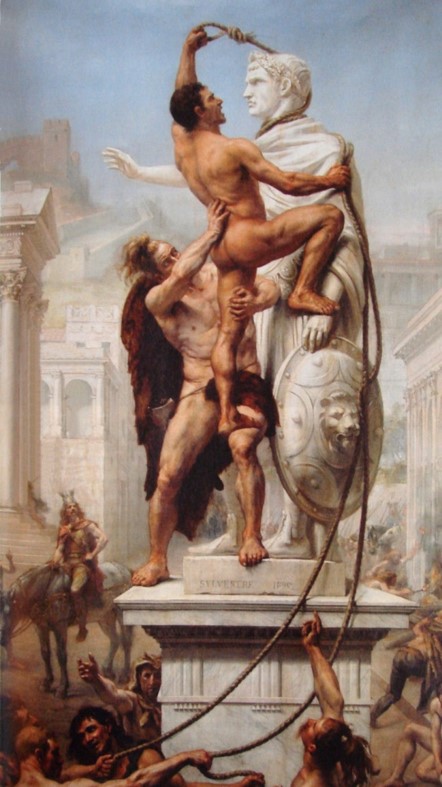
In the 5th century, the need for a strong navy was once again earnest. The Germanic invaders, who were originally land-based bands of warriors and migrants, were learning the art of naval warfare. Their piratical raids now threatened the heartland of the Empire. The Vandals, in particular, invaded and established themselves in Libya by crossing the strait of Gibraltar. Their kingdom posed a direct threat to Rome itself. The Mediterranean was again the sea of pirates after four hundred years of Roman peace. A lack of navy was keenly felt.

Finally in 533 AD, the Roman Emperor Justinian made a serious attempt to deal with the Vandal problem. He sent an expeditionary taskforce led by Belisarius, who quickly defeated the Vandals. However, in Italy, a prospect of peacefully reacquiring the whole country from the Goths was foiled. Thus, in 535 AD, Belisarius was sent to conquer Italy and to restore the city of Rome to Roman rule. This Gothic War, however, turned out to be a quagmire for Rome. Belisarius easily captured Rome but was then besieged by the Gothic horde for one whole year. Even though his daring strategic manoeuvres led to capture of Ravenna, the Gothic capital and the seat of the Roman court previously, the Goths would renew hostilities and recapture the whole of Italy under their new king, Totila. Belisarius had to go back for his second tour of duty, but he would suffer from lack of supplies, reinforcements and morale. The war had devastated Italy, impoverishing local inhabitants, who were no longer disposed favourably towards the Romans. This naturally did not help lift morale of Roman leadership. The element of surprise was also gone – in the first campaign, the Goths were not ready for war with the Empire, as they really didn't believe that the Romans would actually start war against them. (Also they were busy fighting the Franks.) They were constantly outfought and outmanoeuvred by Belisarius.
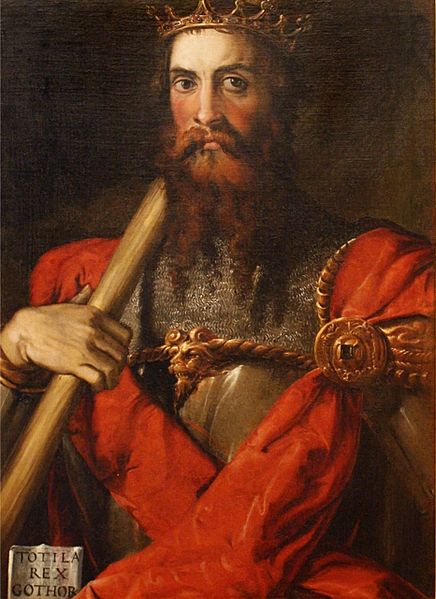
Totila, however, obviously learnt Belisarius' tricks and always made moves to pre-empt whatever Belisarius might do. Belisarius could no longer defeat the Goths from a position of numerical inferiority. He appealed again and again to Justinian to send him reinforcements, supplies and money. Money was the most important, as the majority of his troops were paid professionals. When they didn't get paid and fed, they could easy switch sides, which Totila readily exploited. The best Belisarius could do was to control the most vital ports for communication between the Empire and Italy to keep Roman prospects alive. The Empire, however, was hard pressed by other problems. The Balkans was a hotbed of troubles, where waves of invading tribes had to be stopped. The famous Justinian's plague also broke out in the midst of the Italian campaign in 541 AD. The plague sapped manpower, money and psychological strength of Romans.
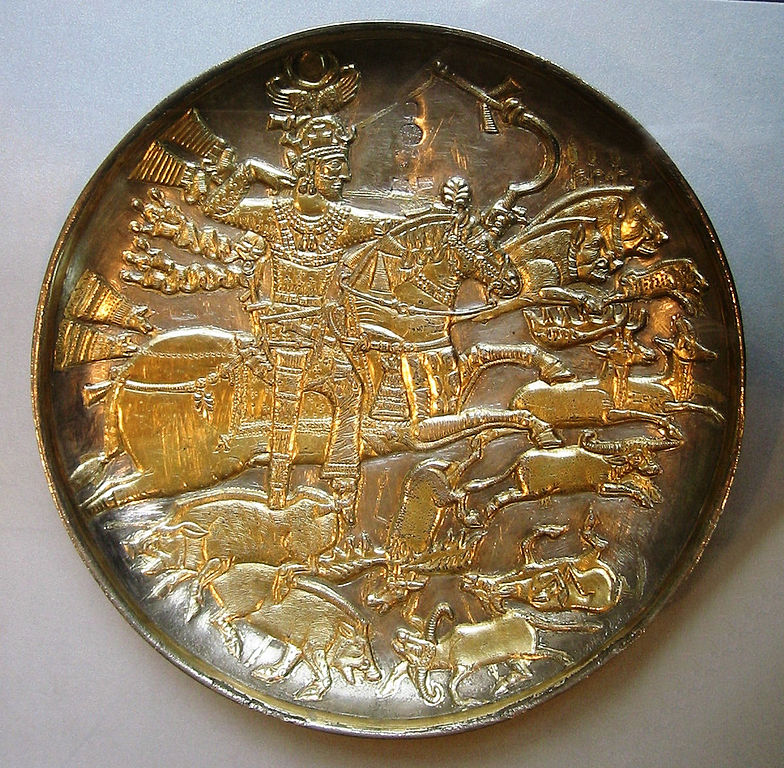
Totila also appealed the Persian Empire to intervene. The Persians were of course the worst enemy of the Roman Empire. Some modern historians wonder why Justinian bothered to wage war in Italy when Persia was by far the most serious security problem for Rome. Fortunately, the Persians did not do much to threaten Rome this time. Yet, their incursions were enough to divert resources and attention from west, allowing situation in Italy to deteriorate. By the end of the 540s, the Romans were just clinging on to some ports on the Adriatic. All remaining Roman forces were hemmed in coastal areas near these ports. But finally Justinian, having recovered from the plague, the loss of his wife, Theodora in 548, and sorted out other security problems at least temporarily, resorted to end the war in Italy once and for all by applying a surge strategy.
A large army was assembled under the old eunuch general Narses who marched overland towards northern Italy. But naval communication was vital. According to Procopius, who recorded this war, northern Italy was reasonably secure at this stage. Yet, previously, Belisarius had always been handicapped because this northern route from western Balkans into northern Italy was blocked due to invasion of nomadic tribes from north. Narses's rear was by no means secure. Sea communication was still essential for successful execution of his new campaign. Totila, of course, knew it. He had been challenging Roman dominance at sea, building and acquiring fleets of his own, disrupting Roman sea communication, raiding Imperial territories in Greece and elsewhere. But, as Narses was about to be on the move, it came down to one fleet battle near Ancona (Ancon), known as the battle of Sena Gallica (Senigallia) (551 AD). This battle is virtually ignored by modern historians as a mere sideshow or just a prelude to the truly decisive final battle in which Totila was killed (553). Most Classical scholars and Byzantinists were not interested in naval warfare, and if this battle of Sena Gallica is only a naval engagement of a modest scale (only about 100 ships involved), why bother? Only J.B. Bury and W.L. Rodgers dealt with this battle in any meaningful way; more recently, J.A.S. Evans accepted strategic significance of this battle.
The hero of this battle, at least according to Procopius, is a certain John, known as the nephew of Vitalian. Together with his colleague Valerian, he commanded the Roman fleet. This John is a capable but problematic character. During Belisarius's first campaign, John was in charge of a cavalry detachment. After the siege of Rome was lifted, John relentlessly chased the retreating Goths (though he was given a reconnaissance mission) and captured Ariminum (Rimini). This led to a wholesale panic among the Goths – the reader would be left with an impression that if Belisarius had exploited this, he could have ended the war with a total, decisive victory then (538). Instead, he was busy with mopping up operations, leaving John besieged in Ariminum and allowing Milan to be destroyed by the counterattacking Goths. John was perhaps a little rush and headstrong then. Yet, in 551 AD, John appeared to be a seasoned commander and was fully aware of the larger strategic picture. What was about to happen in the vicinity of Ancona was no mere skirmish. This would determine the outcome of war. So John, during his pre-battle pep talk to his troops, points out that Ancona, which was under Gothic siege, was the last port the Romans controlled. Lose it, and they would lose the last hope of recovering command of the seas and henceforth of brining in fresh troops to carry out and to win the war. What really mattered in warfare was logistics, and in this case, especially naval logistics. Without securing it, the size of Narses' forces did not matter.
The Goths, in contrast, seemed to be confident and in an uplifting mood. Their pep talk (again, according to Procopius) shows nothing of strategic rationale. They were feeling totally justified to try to expel Romans from Italy; and with one more push, they'd win. The sizes of opposing naval forces were roughly equal, with both sides deploying about fifty ships. The battle started with a contest of missile firing. With a long naval holiday in Roman times, intricate and precise ship manoeuvring skills of the ancient Athenians were long gone (nearly 1000 years since the battle of Salamis!); most naval battles involved archery contest. Indeed, Romano-Byzantine warships (called the dromons) from later centuries show similar configuration to that of modern combat vessels, with structures like gun turrets in the mid section of the ship erected, providing archers with a secure platform.
After the missile combat phase, in which the Romans blunted charging Gothic foes, ships closed in for melee. Roman abilities to fight in good formation began to tell. As the Goths had been damaging Roman naval power for the past decade in the absence of strong naval opposition, they did not gain much experience in actual naval combat. The Romans got a similar problem; yet, their sailors were better drilled and trained according to accumulated wisdom of naval warfare, presumably. The Gothic fleet lost cohesion and the Romans seized the chance. Any straggling Gothic ship was rammed and boarded. The main action was hand-to-hand combat by boarders. Hard pressed, the Goths gave way; the Romans sensed it and moved in for a kill. The Gothic retreat became a rout; surviving Gothic ships were abandoned and burned on a beach. The crew and warriors fled further inland.
Procopius concludes this account by implicating that the Gothic morale was now broken, even though modern historians were reluctant to take this at face value. Still, it is quite possible that, knowing the strategic picture of the whole war, it dawned on the Goths that the war would go on indefinitely until they were subdued. For their bravado and optimism, the Goths were war weary. So, when the main Roman force of Narses showed up (553), the Goths and in particular, their king Totila seemed to have lost their nerve. They were usually such cool customers but now they were fighting like berserk savages who knew nothing about strategy and tactics. They were simply overwhelmed by Narses. Totila fled but died of his wounds or because a stray arrow hit him.
Thus after twenty years' struggle, finally, the Empire recovered Italy. Yet, the end was an anti-climax. Procopius himself at first did not even bother to conclude his account of the war. In retrospect, all was in vain, as Italy would be lost to the newcomer Lombards soon; in fifty years after the end of this war, the Persian Empire would invade and nearly destroy the Empire; and in the middle of the seventh century, the Arabs would come out with a new religion, Islam, to conquer Egypt and Syria. The Roman Empire would reinvent itself and re-emerge as a regional superpower in the middle ages – yet, its political and cultural makeups were so different from those of the Empire that had shaped the Classical world historians today refuse to call it Roman. We call this empire Byzantium.
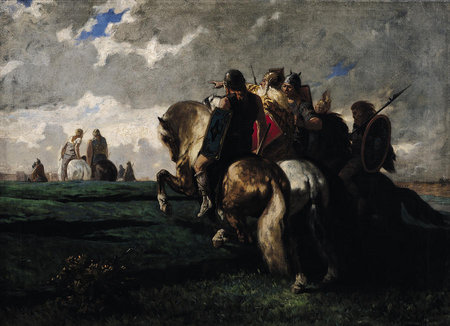
Justinian the Great is often called the last Roman Emperor and Belisarius the last great Roman general. But this minor naval engagement off Ancon is a testimony that the Roman Empire's legacy of military experience was still a great asset for the beleaguered Romans in the east. Worn out by constant warfare and fighting its expeditionary warfare with small task forces of mercenaries, the Roman Empire still boasted the best system of logistics and communication that enabled it to concentrate its material and human resources in order to beat barbarians. This naval battle is further proof that the Empire was still 'Roman' in Justinian's time.
Bibliography
Ahrweiler, H. (1966). Byzance et la Mer. A Marime de Guerre la Politique et les Institutions Maritimes de Byzance anx VIIe-XVe siècle. Paris.
Bury, J. (1958). History of the Later Roman Empire. From the death of Theodosius I to the death of Justinian. 2 vols. (Dover edition ed.). New York: Dover Publications.
Cameron, A. (1996). Procopius and the Sixth Century (Routledge ed.). London and New York: Routledge.
Evans, J. (1972). Procopius. New York: Twayne Publishers.
Fauber, L. (1991). Narses, Hammer of the Goths. New York: St. Martin's Press.
Procopius. (1914-40). History of Wars, 6 volumes. (H. Dewing, Trans.) London.
Pryor, J. H., & Jeffreys, E. M. (2006). The Age of Δρομων: the Byzantine Navy ca500-1204. Leiden and Boston: Brill.
Rodgers, W. L. (1996). Naval Warfare Under Oars 4th to 16th Centuries. A Study of Strategy, Tactics and Ship Design. Annapolis: Naval Institute Press.